Private beta now open.Request access

Built for CMS GUIDE Model participants

Care navigation that actually gets done.

GentleNext is the software layer for CMS GUIDE dementia programs. Navigators spend their time with families, not documentation. Programs see every billable moment and every compliance attestation.

  • Offline-first family PWA
  • Software only — no services bundled
  • PBA-ready on day one

Two simulated scenarios — caregiver and navigator. No signup, no real patient data.

Navigator console

GEN-Eleanor-B
HighStrain
GEN-Margaret-A
ModRespite cap
GEN-Walter-I
Mod-High
SOAP draft — awaiting review

Assessment

Caregiver strain elevated. No acute safety concern.

Approve
Edit

Family app

Today

Margaret has a doctor's visit Tuesday at 2:00 PM. Read the brief before you go.

From Priya, your navigator

Refill Donepezil at CVS

Before Tue, 2:00 PM

I need help now

Navigator console (left) + family PWA card (right).

Ships HIPAA-ready on day one

  • Built for the CMS GUIDE Model

    G-code-aware billing, tier-aware cadence

  • HIPAA Business Associate posture

    BAAs on file with Microsoft, DigitalOcean

  • Hash-chained audit log

    7-year retention, operator-verifiable

  • PHI never leaves the tenant

    Row-level security, per-request tenant GUC

How it works

Two apps. One coordinated workflow. The navigator acts; the family sees the result.

  1. Navigator

    Reviews the situation

    The navigator reviews assessment scores, contact history, and the family's recent messages. The full clinical picture is in one place.

  2. Navigator

    Publishes a next step

    The navigator writes or approves what the family should do next. AI may draft; the navigator always reviews before anything reaches the family.

  3. Family

    Sees one clear action

    The family app shows one thing: what to do today. No dashboard, no notification center. A one-sentence next step in the navigator's voice.

  4. Both

    Urgent concerns route to a human

    If the caregiver flags an urgent concern, it goes to the navigator on call. AI does not intercept or resolve crisis contacts. A human always responds.

The GUIDE model is a huge opportunity. And a documentation tax that just got harder.

321 surviving programs, mid-PY2, first PBA cycle. The three pains cohort 1 reported.

Navigators were under-staffed by design.

Cohort-1 programs underestimated navigator hours per dyad. The fix isn't more navigators — it's per-navigator leverage. SOAP draft, tier change, contact log, training hours all in one console; documentation that closes when the call ends, not the next morning.

Families get portals, not partners.

An adult daughter at 2am needs one calm sentence, not a password reset. Senior-living operators report the family-education gap is killing outreach funnels. The family side has to feel like a navigator wrote it, because one did — never an open-ended chatbot.

PBA started in January. Most programs aren't ready.

The Performance-Based Adjustment first applied PY2 (now). Eligibility, referral pathways, and respite operations are the three published sinkholes. GUIDE billing already hinges on documented contact cadence, G-code attribution, and assessment-to-action evidence — PBA tightens it. Reconstructing that quarterly by spreadsheet is no longer survivable.

Two apps. One case.

Navigators get a console. Families get a card.

GentleNext is one platform with two intentionally separate interfaces — because an RN building a care plan and a daughter reading it at 2am have completely different needs.

Navigator console

Dense, operational, keyboard-first.

The navigator sees a caseload table with burden-risk flags, overdue-cadence indicators, and tier classifications. Assessments, contact logs, escalation routing, and GUIDE-compliant documentation export are all one click away. The AI doc-assist produces a structured SOAP draft the navigator edits and approves before anything is filed.

  • Caseload with overdue-cadence and burden-risk flags
  • Structured ZBI / CDR / FAST assessment flow
  • Contact log → SOAP draft → navigator approval
  • Escalation routing to on-call clinician
  • Monthly DCMP billing export (G0550 / G0553 / G0556)

Audience: RN, LCSW, care coordinator — 4–8 hours/day at the screen, desktop-first.

Family PWA

Calm. One next step. No password.

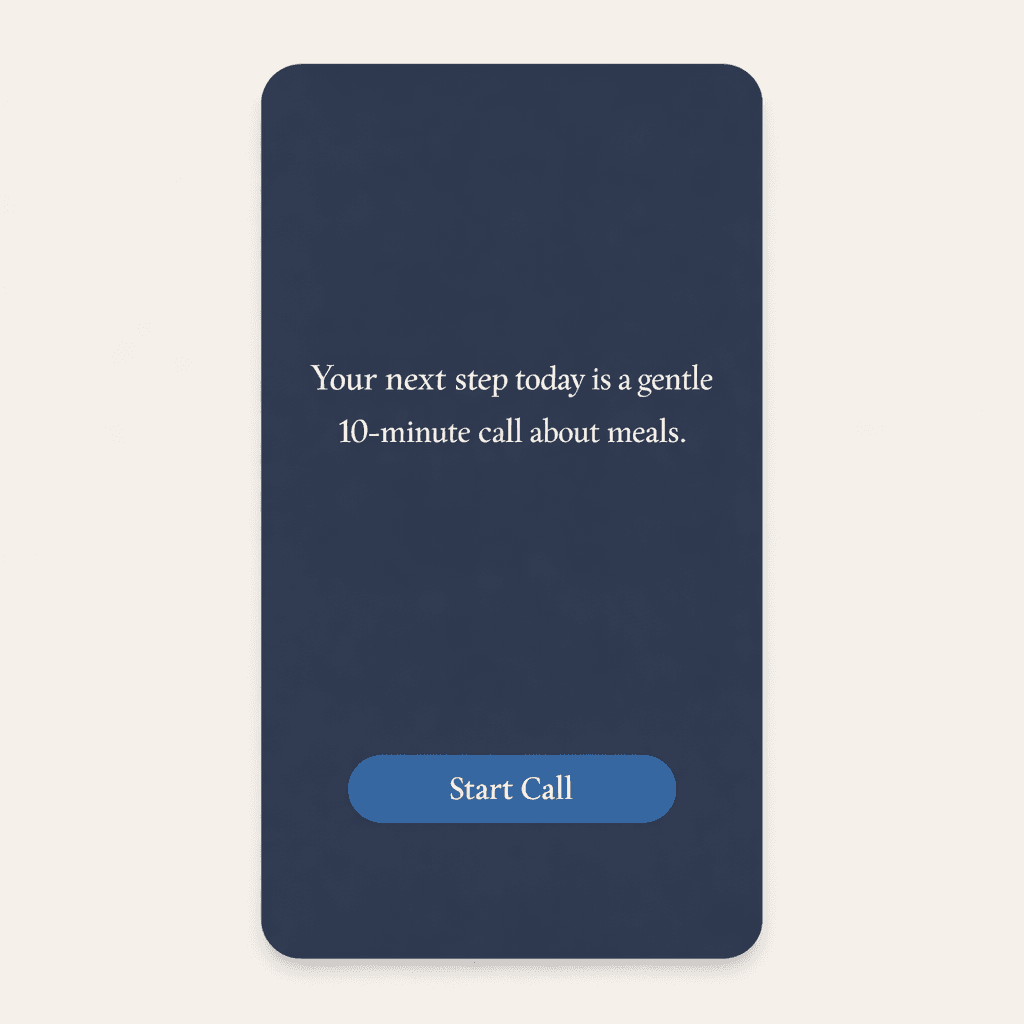
The family caregiver opens a magic-link on her phone. She sees one sentence — what to do today, from her navigator by name. Large text, 56×56 tap targets, dark-mode default, no gamification. If something is wrong, one tap reaches a human.

  • Today card — one calm sentence, one primary action
  • Task board — coordinate siblings without group chats
  • Visit prep brief — one page before every doctor visit
  • Secure messages with the navigator
  • Urgent concern → human within 15 minutes, always

Audience: family caregiver, age 55–75, short sessions, often late at night. No account creation — magic-link only.
How they connect: When a navigator logs a contact, updates a care plan, or publishes a visit-prep brief, the family sees it on their next open — not as a notification flood, but as a single updated card or task. The navigator is always named. The family always has a human to reach.

What programs actually face

GentleNext is built around the situations that happen every week in GUIDE programs.

Newly diagnosed

Margaret was just diagnosed.

Sarah, her daughter, doesn't know what to do first. Priya, the navigator, enrolls the family, completes the ZBI, and publishes a single next step to the family app. Sarah sees it that evening.

Enrollment + ZBI: ~12 minutes. Sarah's first calm next step: same day.

Overdue reassessment

Six months have passed.

The ZBI is due. GentleNext surfaces it in Priya's caseload before it becomes a compliance gap. Priya schedules the call, documents the score, and the GUIDE reporting record updates automatically.

Surfaced 14 days before the cadence breach. Reporting record: instant.

Urgent concern

Sarah called 911 last night.

She opens the family app and taps 'I need help now.' The concern routes to the on-call navigator. AI does not answer. Priya calls back within the hour and documents the contact.

Routed to a human in under 60 seconds. Callback target: 60 minutes.

Visit prep

Appointment is next Tuesday.

Priya drafts a one-page brief: current medications, cognitive scores, and the three questions to ask the geriatrician. Sarah can read it or print it. No login required.

Draft: ~90 seconds (AI). Navigator review + publish: ~5 minutes. Sarah sees it: instant.

Software that respects both your navigators and your auditors.

Not a feature tour. Three moments the software was built around.

Documentation workflow

Draft in the workflow. Approve before it files.

Every contact closes with a structured SOAP draft the navigator edits and approves. Clinical-advice language is blocked at generation time. Every AI call is logged with prompt and model version so a reviewer can retrace the decision two years later — without digging through email.

Family PWA

One card. One next step. No password.

Caregivers open the app at 2am. They see one calm sentence, one primary action. Large type, 56×56 tap targets, no streaks, no dark patterns, no red. Installable offline-first so the sentence still shows up when the WiFi doesn't.

Family PWA card on a phone mockup — one calm serif sentence and one action
GUIDE-billable by default

Every contact, every G-code, every attestation.

Eligibility checks at intake. Tier-aware contact cadence monitoring. Monthly DCMP billing that runs idempotently and exports to a CSV that matches the CMS-1500 specification. Re-running the export is safe — unchanged rows are skipped.

Security & compliance

Everything you need for HIPAA is already on.

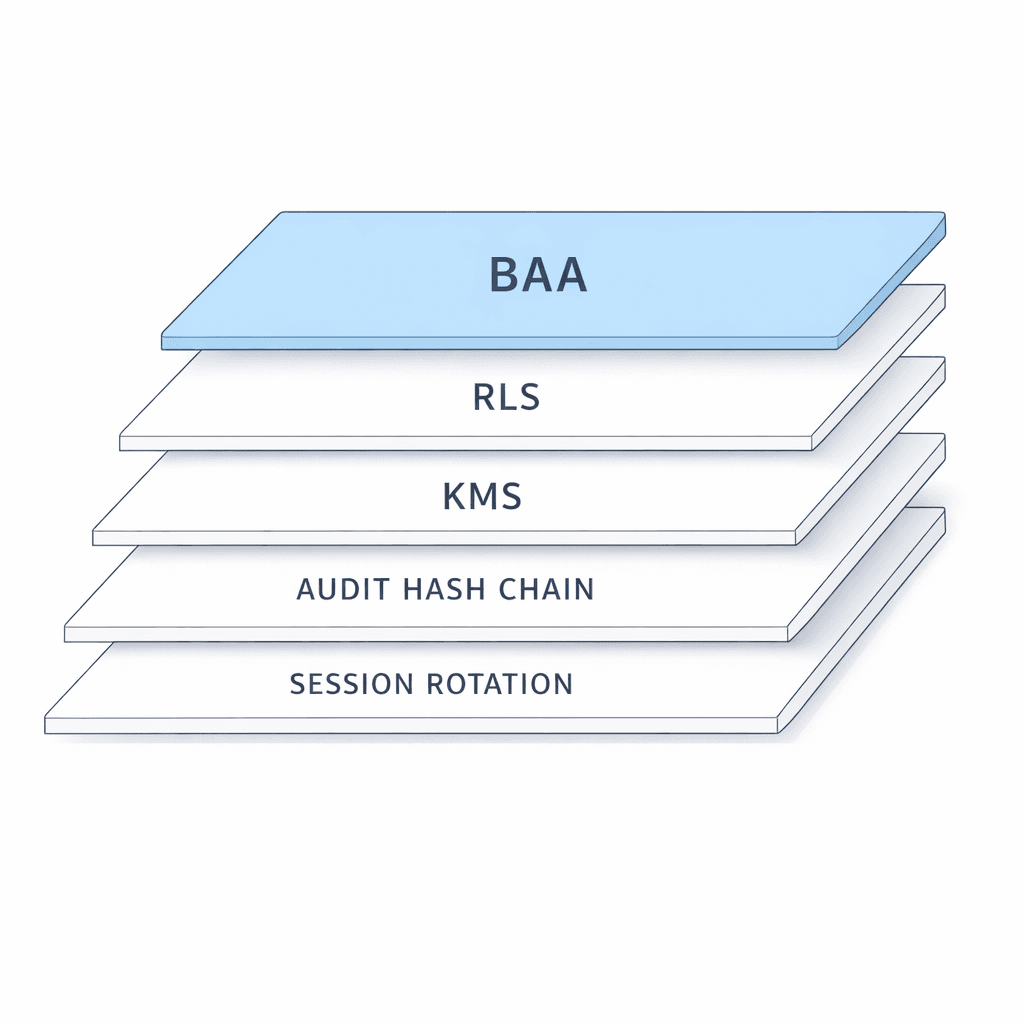
PHI never lands in a vendor log. Audit retention is seven years. Your CISO can walk a reviewer through the defense-in-depth without a demo.

Layered cards naming each compliance primitive in the stack: BAA, RLS, KMS, audit hash chain, session rotation
  • BAA

    Microsoft (Graph mail, Azure OpenAI), DigitalOcean Managed Postgres, DO Spaces.

  • Tenancy

    Row-Level Security on every tenant table, re-validated per request via a per-request tenant GUC.

  • Keys

    Per-program KMS-wrapped DEKs with lazy unwrap + 5-minute memory TTL + transactional rotation.

  • Audit

    SHA-256 hash-chained AuditLog with a verifier endpoint and per-field encrypted diff log.

  • Sessions

    Family magic-link sessions rotate on auth change; HttpOnly + SameSite=Lax + Secure in prod.

  • No third-party analytics on family surface

    No GA, no Mixpanel, no session replay. First-party telemetry only.

PMPM pricing aligned with your GUIDE attribution.

Flat across tiers so you don't pay more when a beneficiary moves to a higher-acuity tier. Every plan includes navigator training, launch support, and a curated community-resources library seeded for your state.

Pilot

Starter program

Up to 250 beneficiaries. Ideal for a single GUIDE-participating clinic or memory center standing up its first cohort.

$45/ beneficiary / month

Minimum 25 attributed beneficiaries.

  • Navigator training for up to 5 nurses
  • Launch support (30-day white-glove onboarding)
  • State-seeded community resource library
  • Production tenant
  • Quarterly compliance review

Scale

Multi-site health system

250+ beneficiaries across one or more GUIDE programs. Volume tiering kicks in at 500, 1,000, and 2,500 beneficiaries.

$28$38/ beneficiary / month

Exact rate locked at contract based on attribution count + track.

  • Unlimited GUIDE programs on one tenant
  • Shared resource library across sites
  • SCIM user provisioning
  • Dedicated production per site
  • Monthly compliance review + named security contact
Tell us about your program

Annual contract, invoiced monthly. No per-seat fees for navigators.

Who this is for

GentleNext is purpose-built for structured dementia care programs, not general caregiving apps.

GUIDE-participating programs

The 321 surviving cohort-1 programs entering the first PBA payment cycle. Assessment workflows (CDR, FAST, ZBI, HRSN), DCMP PBPM tracking, five-tier classification, respite cap enforcement, and the GUIDE reporting export — wired end-to-end. PBA-ready on day one.

Memory-care service lines

Health systems running memory-care outside GUIDE get the same navigator workflows — assessment cadence, caregiver-burden tracking, care plans, family communication — without the CMS G-code reporting and PBPM modules. Same console, narrower compliance surface.

Geriatric practices

Practices with a care-coordination function use GentleNext between visits: post-appointment follow-through, ZBI-tracked caregiver burden, family-side resource handoff, escalation routing to the practice's own on-call. Reduces re-asking the same questions visit-over-visit.

Medicare Advantage dementia programs

MA plans operating dementia-specific supplemental benefits or in-house care-navigation teams use the same workflows their plan-side care managers already follow, with HIPAA-aware tenant scope per plan and a calm family surface their members will actually open. Not employer-side caregiver concierge; plan-operated programs only.

Common questions

About

Built by operators, not platform tourists.

GentleNext is a product of Mahumtech, an engineering studio that ships HIPAA-grade software for regulated healthcare programs. The platform is maintained by a small senior team — clinical advisors, a care navigator, and the engineers who wrote the audit layer — not an outsourced contract shop.

We are pilot-stage and say so out loud. That means we over-invest in launch support, we write detailed compliance briefs for your CISO, and we answer every email within a business day. If you're considering us, expect to talk to the team that wrote the code — not a BDR.

Founded
2025, Brooklyn NY
Stage
Pilot partners, waitlist open

Book a demo

30 minutes. We'll bring the scenarios.

We'll walk the navigator console with your expected tier mix, run the AI doc-assist on a realistic contact, and show you the quarterly reporting + billing export paths. You leave with a compliance brief you can forward to your CISO.

Response time
One business day.

We keep this to ourselves. No third-party analytics, no lead-enrichment services, no list rentals.